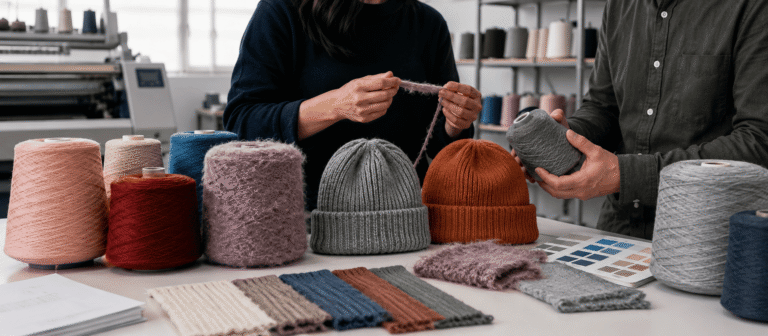

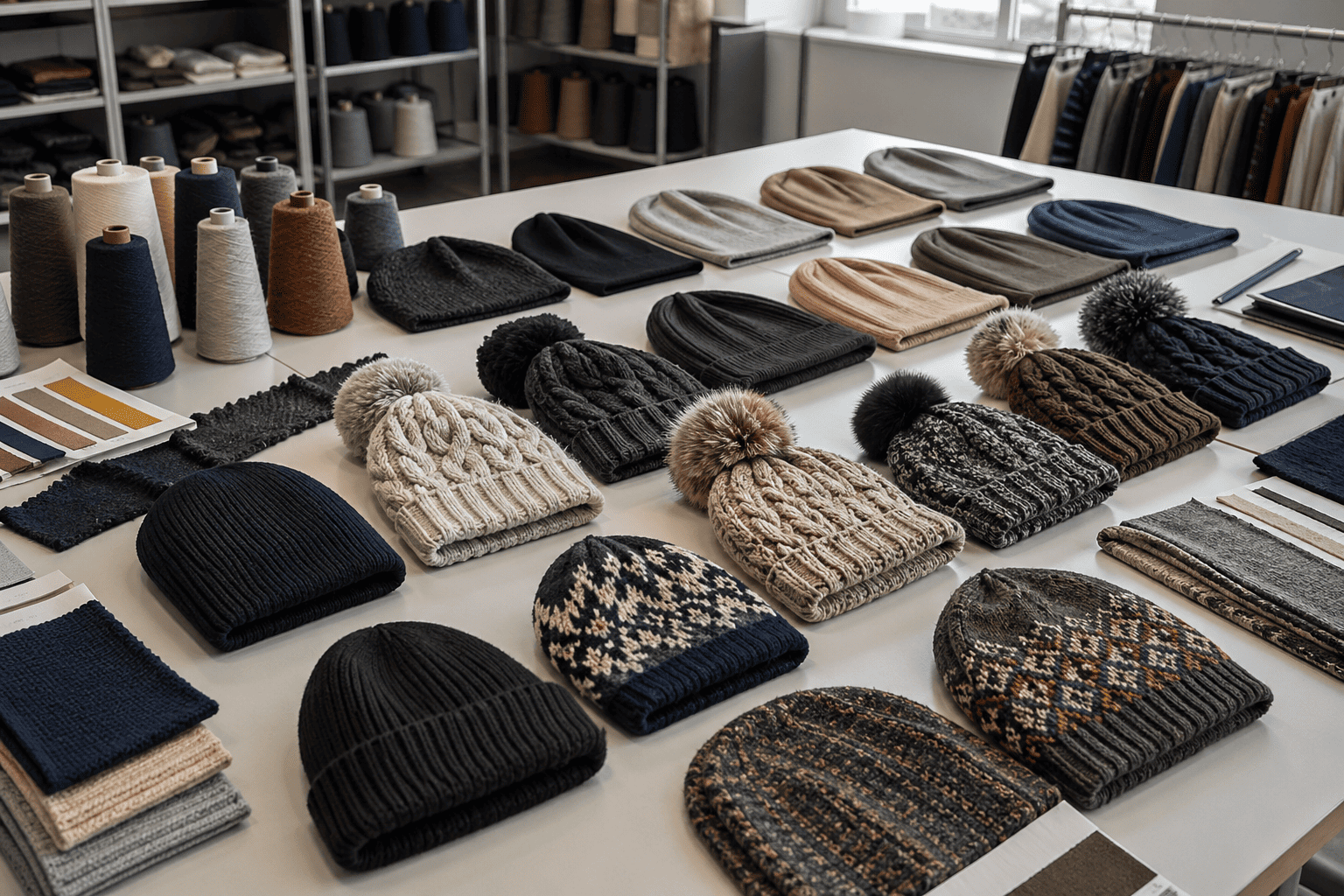
Are you confused by beanie terminology? Choosing the wrong type can waste time and money. Understanding the core manufacturing methods is the key to getting the product you actually want.
The main types of machine-knitted beanies are defined by their production method: circular knitting or flat knitting1. The choice impacts everything from style and warmth to customization options and final cost, making it more important than just a simple style name like "cuffed beanie."
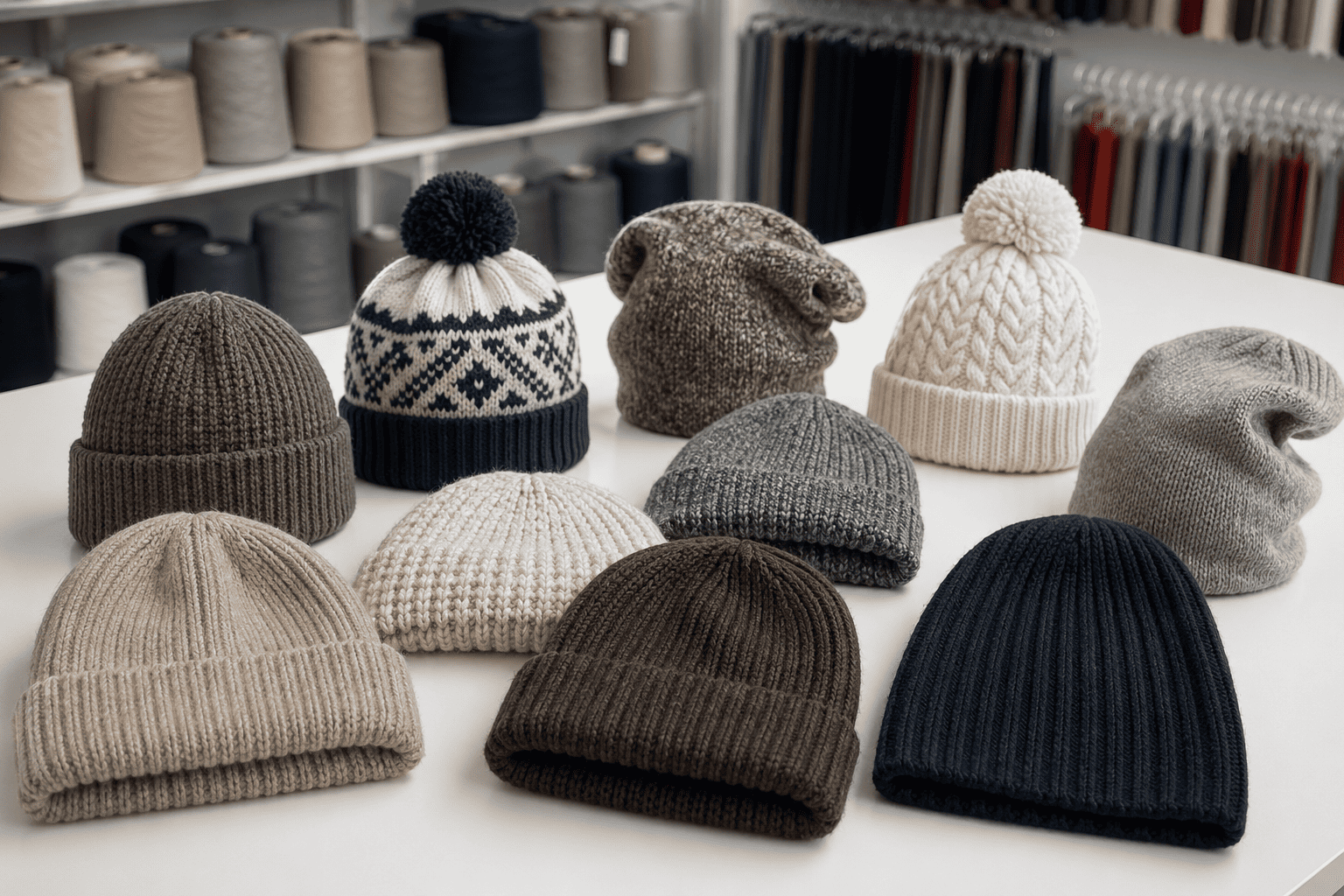
When I talk with new buyers, the conversation often starts with a style name. They'll ask for a "plain beanie" or a "jacquard beanie." This makes sense from a design perspective, but from a factory's point of view, it's only a tiny part of the story. The real difference lies in how the beanie is made. This single decision affects the yarn we can use, the texture, the warmth, and even the price. To really understand beanies, you have to look beyond the surface and into the machines that create them. Let's dive into the two main production paths.
What Are Circular Knit Beanies?
Do you need a large volume of beanies produced efficiently and consistently? You might worry this limits your style options, but circular knitting is a great solution for many popular designs.
Circular knit beanies are made on a circular machine that knits a seamless tube of fabric2. They are typically double-layered for a clean finish and are ideal for high-volume production3 of styles like plain beanies or beanies with repeating jacquard patterns.
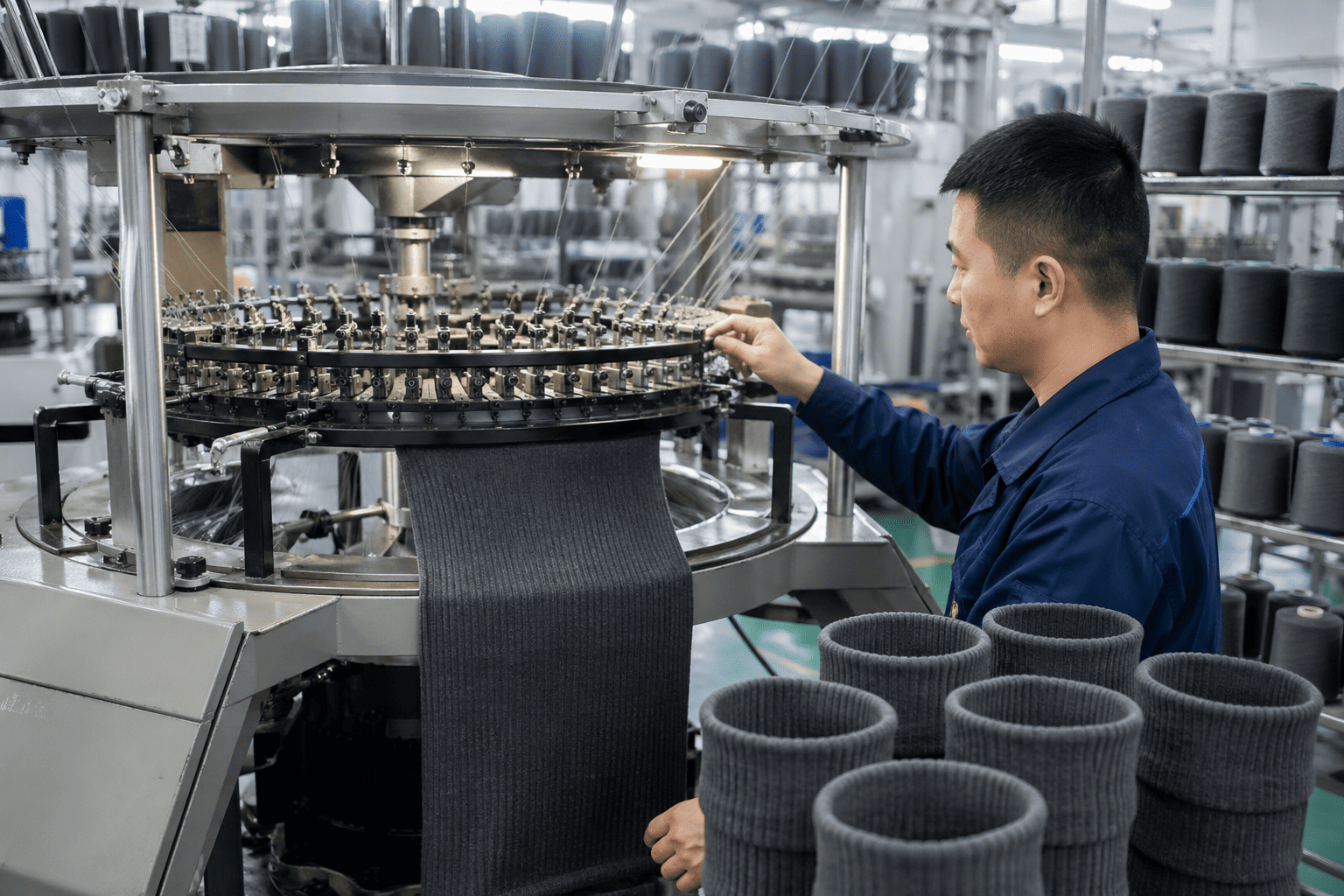
Circular knitting is the workhorse for many classic beanie styles. The process is fast and very stable, which is why it’s so common. But the machine itself introduces some specific characteristics. For example, the size of the machine's cylinder and the number of needles it has directly control the final product4.
How Machine Needles Affect the Fit
In our factory, we use machines with different needle counts, like 320, 360, 400, 420, or even 440 needles. A machine with more needles creates a wider tube, which results in a beanie that fits a larger head. A machine with fewer needles makes a smaller beanie, perfect for children. This is why we always ask about the target market. A beanie for the Russian market might need a different fit, and therefore a different machine, than one for the Italian market. The needle count also influences the stretch and density of the fabric.5
| Needle Count | Typical Use Case | Characteristics |
|---|---|---|
| 320 Needles | Children's Beanies | Smaller circumference, tighter fit |
| 360 Needles | Youth / Small Adult | A common intermediate size |
| 400-420 Needles | Standard Adult Beanies | Good stretch, fits most adult heads |
| 440 Needles | Large Adult / Slouchy Fit | Looser fit, wider circumference |
Common Structures and Limitations
Most circular knit beanies are made to be double-layered.6 The machine knits a long tube, which is then cut, closed at the top, and folded inside itself to create two layers. This gives the beanie a clean finish and extra warmth7. While we can create patterns like drop-stitches or rib-like textures, the overall structure is less flexible than other methods. True single-layer beanies are rarely made this way because the raw edge would be difficult to finish cleanly8. This focus on efficiency makes circular knitting perfect for large orders but less suited for highly complex or unique shapes.
How Are Flat Knit Beanies Different?
Do you want more creative freedom with custom shapes, unique textures, and varied thicknesses? You might think this is too complex, but flat knitting offers incredible design flexibility for your brand.
Flat knit beanies are created on computerized flat knitting machines9. They can be knit seamlessly as a finished hat or made from panels that are sewn together. This method allows for a much wider range of textures, gauges, and complex shapes10.
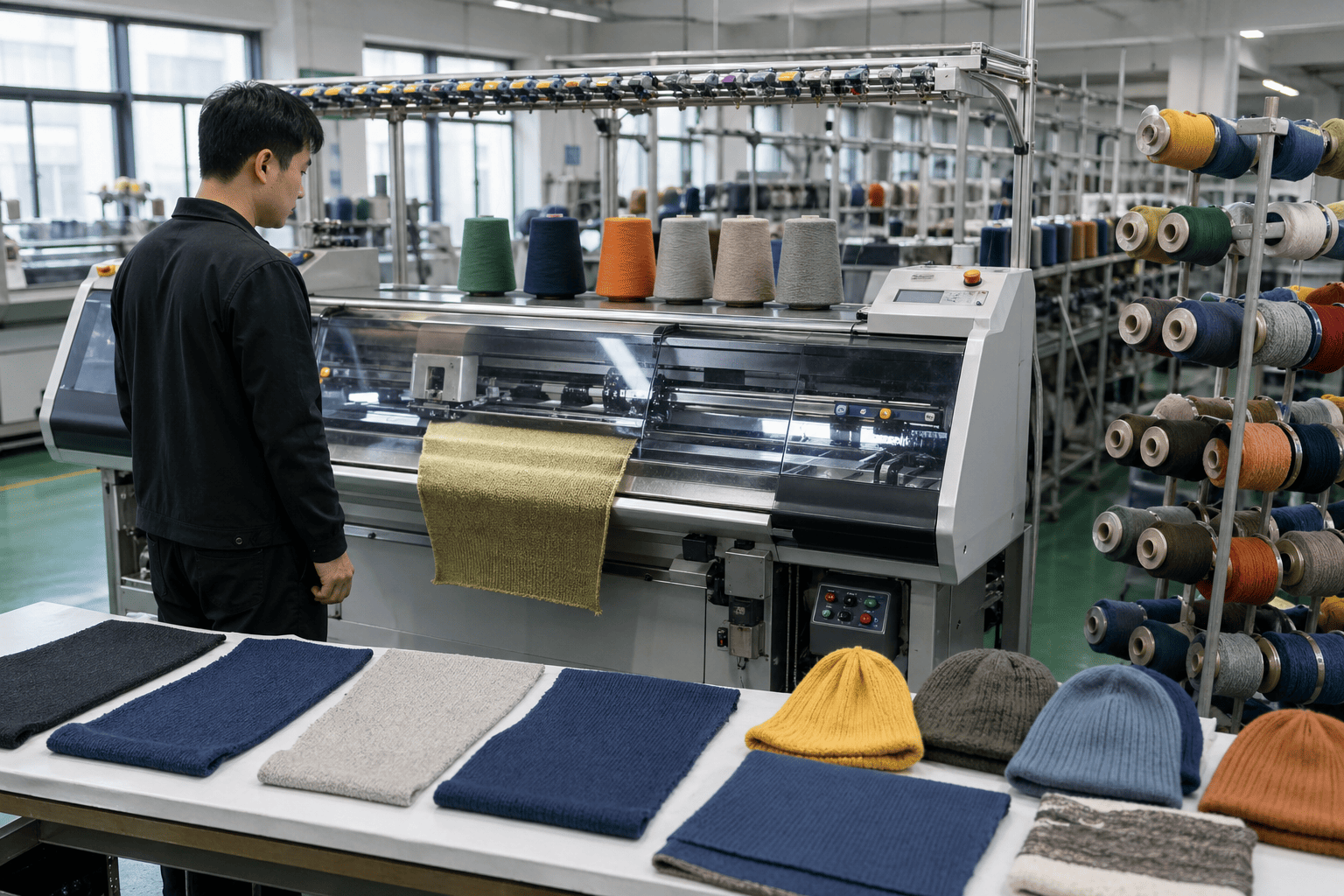
When a client comes to me with a really unique design, we almost always turn to our flat knitting machines. Unlike circular machines that create a tube, these machines knit a flat piece of fabric, just like the name suggests. This opens up a world of possibilities. We can program them to create intricate cable knits, chunky textures, and custom shapes that simply aren't possible on a circular machine. The key to this versatility is something we call gauge.
Understanding Gauge: From Heavy Winter to Lightweight
The gauge of a knitting machine refers to the number of needles per inch.11 A lower gauge number means fewer, larger needles, which knit with thicker yarn12 to create a chunky fabric. A higher gauge number means more, smaller needles, used for finer yarns and a lighter fabric.
| Gauge | Yarn Thickness | Best Use Case |
|---|---|---|
| 3 GG | Very Thick | Extreme cold weather, heavy winter hats (-40°C) |
| 5 GG | Chunky | Standard winter beanies, good warmth |
| 7 GG | Medium | All-purpose beanies, balanced warmth and style |
| 9 GG | Medium-Fine | Lighter beanies, transitional seasons |
| 12 GG | Fine | Lightweight, fashion-focused styles |
| 14 GG | Very Fine | Less common for beanies, used for very fine knits |
I remember a client from Kazakhstan who needed beanies for workers in extremely cold conditions. We used a 3-gauge machine with a thick wool blend and added a fleece lining. The result was a beanie that provided serious protection. On the other hand, as global winters get milder, we see more demand for 5, 7, and 9-gauge beanies. They offer a great balance of warmth, comfort, and everyday style that works for most European markets.
Why Can Beanie Style Names Be Misleading?
Have you ever sent a photo of a "jacquard beanie" to a supplier? Then you were disappointed when the sample felt completely different from what you expected. The problem isn't the name; it's that the name doesn't describe how it's made.
A style name like "cuffed beanie" or "jacquard beanie" only describes its appearance, not its construction. The same style can be made using either circular or flat knitting, resulting in huge differences in feel, stretch, quality, and ultimately, cost.
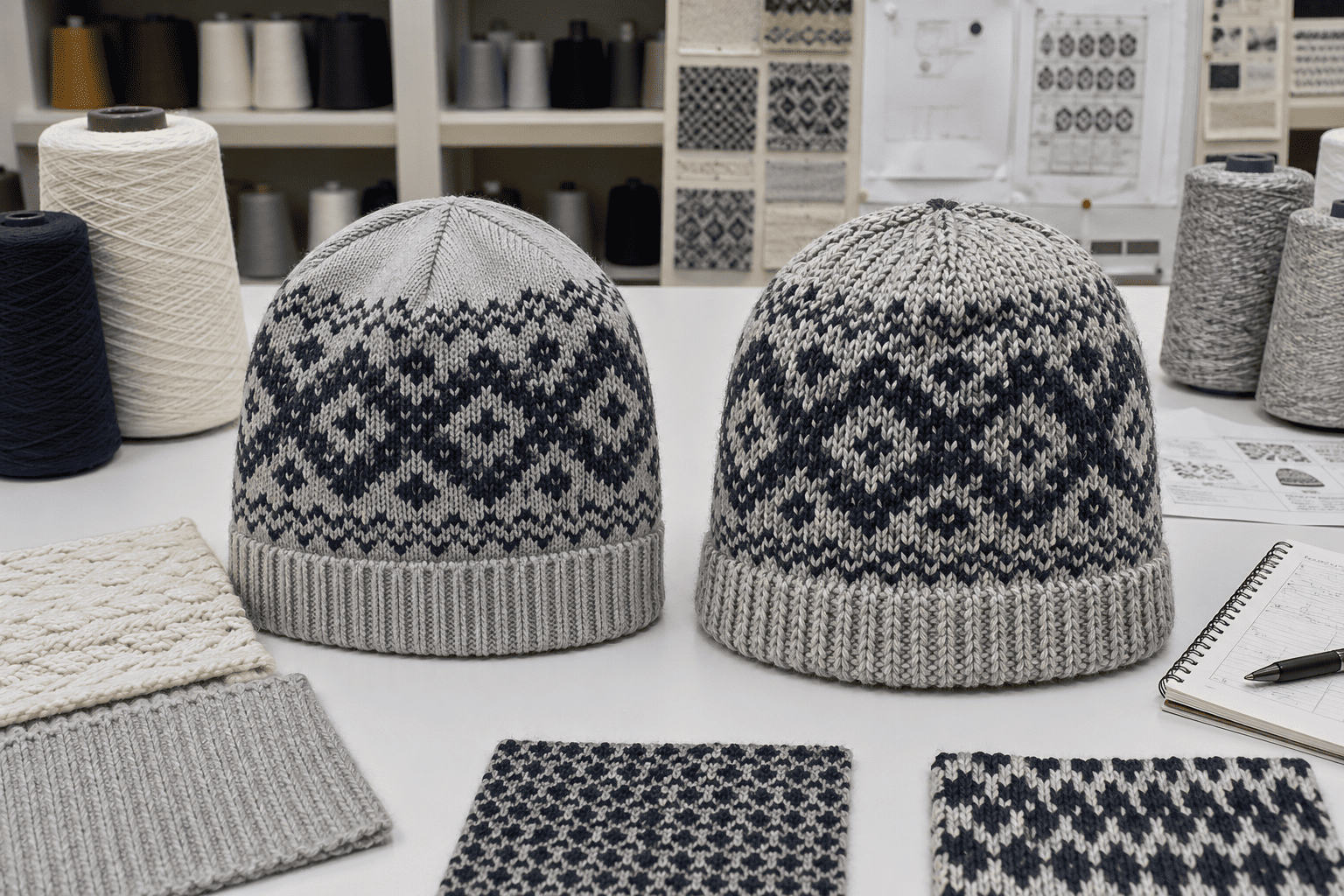
This is one of the biggest sources of confusion I see in my daily work. A buyer might have a specific product in mind, but if we don't know the manufacturing details, we are just guessing. The final product can vary wildly based on the production method we choose. Let's take a common example to see why this matters so much.
Case Study: The "Jacquard Beanie" Dilemma
Imagine you want a beanie with a repeating logo pattern. You call it a "jacquard beanie."
-
Scenario 1: Circular Knit Jacquard. We would produce this on a circular knitting machine. The beanie would be a seamless tube, double-layered, with a relatively fine and consistent texture. The pattern would be integrated smoothly. This method is fast and cost-effective for large quantities.
-
Scenario 2: Flat Knit Jacquard. We could also make this on a computerized flat knitting machine. This would allow us to use a thicker yarn (a lower gauge), giving the beanie a much chunkier, more premium hand-feel. The construction might involve a seam in the back. The pattern might look more defined and textured.
Both are "jacquard beanies," but they are completely different products with different costs and target customers. Without more information, a manufacturer might choose the wrong method, leading to a sample that doesn't meet your expectations.
What Information to Provide Instead
To avoid misunderstanding and speed up the sampling process, it's best to provide more than just a name. I once worked with a brand owner who sent us a complete tech pack, and it was a dream. We got the sample right on the first try. Here is what we find most helpful:
- A clear photo or a physical sample is the best starting point.
- Your target market and wearing season (e.g., "German winter" or "Italian autumn").
- The material you want (e.g., 100% acrylic, wool blend, recycled polyester).
- Your expected price range.
- Details on customization like embroidery, patches, or pom-poms.
This information helps us choose the right machine, gauge, and yarn to create a product that perfectly matches your vision.
Conclusion
Choosing the right beanie is about understanding the manufacturing process, not just the style name. Knowing the difference between circular and flat knitting empowers you to source better products for your market.
"Flat knitting - Wikipedia", https://en.wikipedia.org/wiki/Flat_knitting. A textile manufacturing reference should establish circular and flat knitting as distinct machine-knitting methods, supporting their use as production-method categories for knitted hats. Evidence role: definition; source type: encyclopedia. Supports: The main types of machine-knitted beanies are defined by their production method: circular knitting or flat knitting.. Scope note: The source may define knitting technologies generally rather than classify beanie types specifically. ↩
"Fabric Formation - Textile Technology Center - Gaston College", https://www.gaston.edu/textile-technology-center/sample-production/fabric-formation/. A technical source on circular knitting should explain that circular knitting machines form tubular fabric, which supports the statement that the method can produce a seamless tube. Evidence role: mechanism; source type: education. Supports: Circular knit beanies are made on a circular machine that knits a seamless tube of fabric.. Scope note: The source may describe tubular fabric production generally, not beanie manufacturing specifically. ↩
"Re-evaluation on Causes of Circular Knitting Machine Production ...", https://www.academia.edu/40081539/Re_evaluation_on_Causes_of_Circular_Knitting_Machine_Production_Efficiency_and_their_Impact_on_Fabric_Quality. A textile engineering or manufacturing source should indicate that circular knitting is commonly used for efficient, continuous production of knitted fabric, providing contextual support for its suitability in high-volume beanie production. Evidence role: general_support; source type: education. Supports: Circular knit beanies are ideal for high-volume production of styles like plain beanies or beanies with repeating jacquard patterns.. Scope note: Evidence on general fabric-production efficiency does not directly prove cost or volume advantages for every beanie order. ↩
"(PDF) Effect of Machine Parameters on Knit Fabric Specifications", https://www.academia.edu/3713297/Effect_of_Machine_Parameters_on_Knit_Fabric_Specifications. A knitting technology source should describe how cylinder diameter and needle count determine parameters such as fabric width, loop density, or machine gauge, supporting the claim that these machine specifications affect the finished knitted product. Evidence role: mechanism; source type: education. Supports: The size of a circular knitting machine's cylinder and its needle count directly control aspects of the final beanie.. Scope note: The source may address knitted fabric parameters broadly rather than finished beanie sizing in particular. ↩
"Impact of yarn compositions, loop length, and float stitches on ... - PMC", https://pmc.ncbi.nlm.nih.gov/articles/PMC10407213/. A textile science source should connect needle count, stitch density, or machine gauge with knitted fabric properties, supporting the statement that needle-related settings influence density and stretch behavior. Evidence role: mechanism; source type: paper. Supports: Needle count influences the stretch and density of the knitted fabric.. Scope note: Stretch is also affected by yarn, stitch structure, and finishing, so needle count alone is not a complete explanation. ↩
"DIY Double Layer Knitting Machine Beanie (in 3 Sizes) EASY!",
. A garment-construction or knitting-manufacturing source should document that tubular knitted hats are often finished by folding or doubling the fabric, providing contextual support for the statement about common circular-knit beanie construction. Evidence role: general_support; source type: education. Supports: Most circular knit beanies are made to be double-layered.. Scope note: The word “most” may vary by market and product category, so the source would support common practice rather than a universal proportion. ↩"Comparative Analysis of the Thermal Insulation of Multi-Layer ... - PMC", https://pmc.ncbi.nlm.nih.gov/articles/PMC7344582/. A textile or thermal-insulation source should show that additional fabric layers increase thermal resistance or reduce heat transfer, supporting the claim that a double-layer beanie can provide more warmth than a single layer. Evidence role: mechanism; source type: paper. Supports: Double-layer construction gives the beanie extra warmth.. Scope note: Actual warmth also depends on fiber type, thickness, knit density, moisture, wind, and fit. ↩
"[PDF] Unfabricate", https://www.colorado.edu/atlas/sites/default/files/attached-files/unfabricate_web.pdf. A knitting or garment-construction source should explain that cut knitted fabrics can unravel or require edge finishing, supporting the claim that single-layer tubular knits present finishing challenges at raw edges. Evidence role: mechanism; source type: education. Supports: True single-layer circular-knit beanies are less common because raw knitted edges are difficult to finish cleanly.. Scope note: The degree of difficulty depends on stitch structure, yarn, finishing equipment, and whether bind-off or linking methods are used. ↩
"(PDF) EX Computerized Flat Knitting Machine with Full-Sinker System", https://www.academia.edu/25659028/EX_Computerized_Flat_Knitting_Machine_with_Full_Sinker_System. A technical source on flat knitting should describe modern flat-bed knitting machines as computer-controlled equipment used to produce shaped knitted pieces or panels, supporting the manufacturing description. Evidence role: definition; source type: education. Supports: Flat knit beanies are created on computerized flat knitting machines.. Scope note: The source may discuss knitwear generally rather than beanies specifically. ↩
"[PDF] Knitting Skeletons: A Computer-Aided Design Tool for Shaping and ...", https://cdfg.mit.edu/assets/files/knitting_skeletons.pdf. A knitwear engineering source should explain that computerized flat knitting permits controlled stitch structures, shaping, and variable gauges, supporting the claim that flat knitting offers broader design possibilities than simple tubular production. Evidence role: mechanism; source type: research. Supports: Flat knitting allows a wider range of textures, gauges, and complex shapes for beanies.. Scope note: The range of possible textures and shapes depends on the specific machine model, yarn, programming, and production constraints. ↩
"(PDF) Knitting Machines Needles - Academia.edu", https://www.academia.edu/95883518/Knitting_Machines_Needles. A textile reference should define machine gauge as the number of needles per unit length, commonly per inch, supporting the article’s explanation of gauge. Evidence role: definition; source type: encyclopedia. Supports: The gauge of a knitting machine refers to the number of needles per inch.. ↩
"I figured out how to use a yarn that was slightly to thick on my knitting ...", https://www.reddit.com/r/MachineKnitting/comments/190ef37/i_figured_out_how_to_use_a_yarn_that_was_slightly/. A knitting technology source should explain the relationship between machine gauge, needle spacing, and yarn count, supporting the claim that lower-gauge machines use fewer larger needles and are suited to thicker yarns. Evidence role: mechanism; source type: education. Supports: A lower gauge number means fewer, larger needles, which knit with thicker yarn.. Scope note: Yarn choice also depends on stitch structure, desired hand feel, and machine specifications, so gauge is a strong guide but not the only factor. ↩